
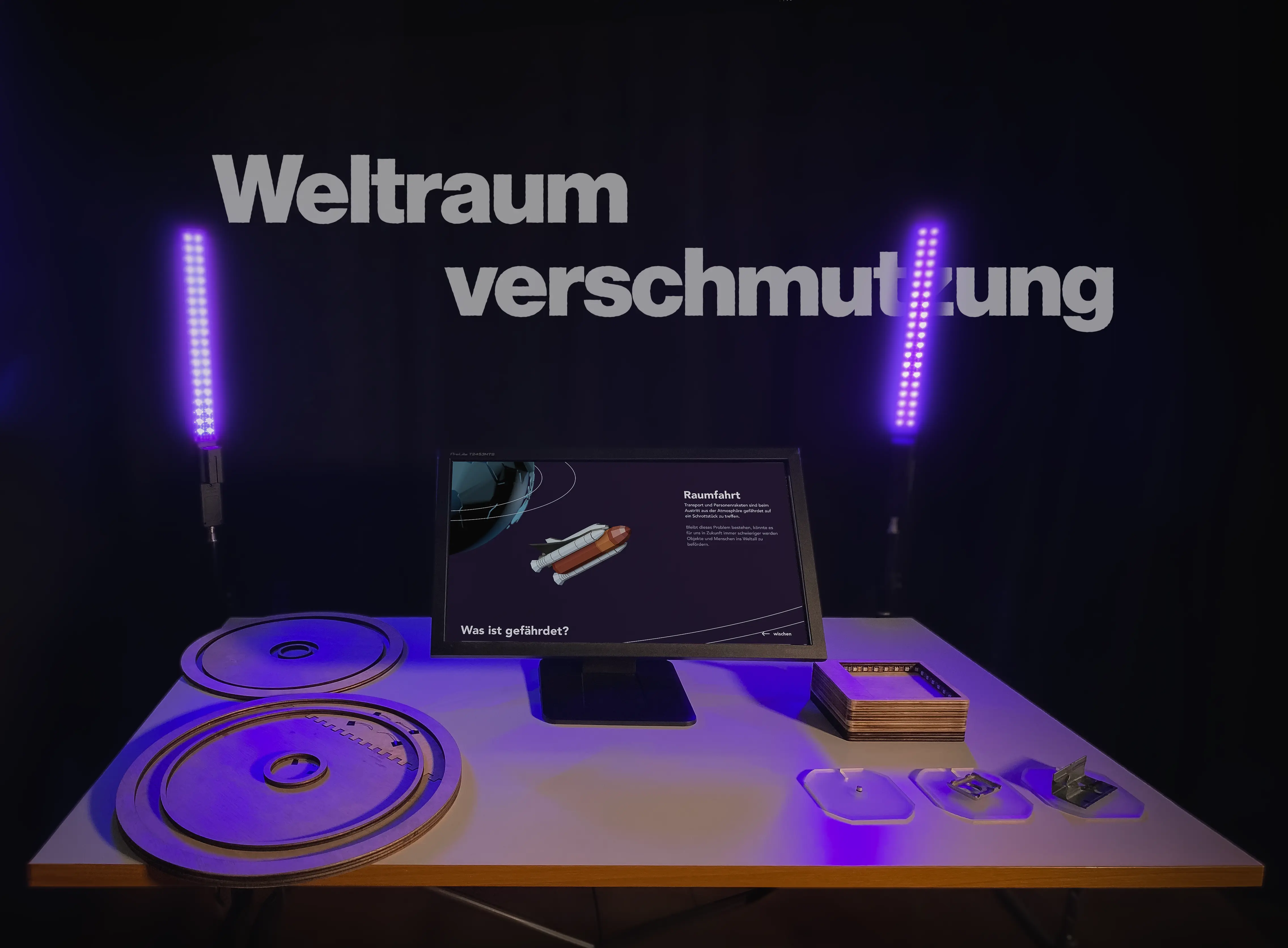
Weltraumverschmutzung.
Case study 10/10 — 2023
An interactive installation that raises awareness for the dangers that might forever keep us from exploring the universe.
- Year
- 2023
- Disciplines
- UX/UI, Prototyping, Arduino, Exhibition Design, Product Design
- Team
- Jens Riesenberg, Emily Kühl
The number of rocket launches and satellites in space is steadily increasing and has implications for our planet. Space pollution can impact our infrastructure, which relies on satellite services such as weather forecasts, GPS, and communication. It can also complicate or hinder future space missions by blocking access to space or jeopardizing the safety of astronauts. With our exhibit, we aim to inform the public about this crucial topic and highlight the dangers and opportunities it presents.
- 3 ways to explore: orbit table, destruction zone and touchscreens
- 1 giant orbit map with grooves like the rings of a record player
The situation.
The number of rockets and satellites soaring into space is on a steady climb, and this growing population has a significant impact on Earth.
Space pollution, a byproduct of this activity, threatens the very infrastructure that relies on these orbiting marvels. From weather forecasting to GPS and communication, disruptions caused by debris could cripple essential services. Even more concerning, this debris field could become an impassable barrier, hindering or even preventing future space exploration and endangering the safety of astronauts venturing beyond our atmosphere. Through this exhibit, we aim to raise public awareness about this crucial issue, exploring both the dangers and opportunities it presents.
The idea.
The growing concern over space debris is driving innovation in technologies for cleaning up our orbital neighborhood.
These advancements hold the promise of a safer space environment, benefiting future spacefarers and missions. Raising public awareness of this issue can further spur international cooperation in developing solutions. By working together, nations can ensure that space remains a safe and accessible frontier for generations to come.
The making.
Imagine stepping into an exhibit that goes beyond just tapping a screen.
We wanted it to be captivating and informative, a place where you could truly understand the challenges of space debris. One way we did this was by creating a giant map of space orbits. It wasn't flat though, picture a table with grooves carved into it, like the rings of a record player. You could pick up rings, each representing a different sized orbit, and slot them onto the grooves. And through a closed circuit the screen switches what is displayed showing you exactly how much debris is around in that zone, how fast it was moving, and even any satellites that were bravely exploring alongside it. It was a hands-on way to see how space is divided up, and why some areas are more crowded and dangerous than others.
We also wanted an activity that got you away from the screens altogether. So we created a 'destruction zone.' Here, you could pick up pieces of debris, some small, some the size of a golfball. Place your chosen piece on a platform, and then the screen would come alive with an animation. You'd see a satellite in space, when suddenly your debris would slam into it, creating a spectacular show of destruction. The bigger and faster the debris you picked, the more intense the crash. It is a way to experience the destructive power of space junk visually without having to imagine all the differe.
Pick an orbit.
Interactive model
Like the rings on the orbit table: choose an orbit to highlight it. Drag to turn the planet.
The outcome.
Of course, there are still some touchscreens around for the independent exploration of other information.
But we wanted to offer a mix of ways to learn and explore at an individual pace. Through this we hope to raise awareness of the dangers of space debris and the importance of keeping our orbits clean.
Related links.
If you liked the project or have feedback, feel free to contact me.
 Next frame — 01/10 A digital cave archive: precise 3D capture in the field and secure, anonymised data sharing for science. View project